How to Scale Marketing for Your Plumbing Business: A Step by Step Growth Plan
10 Min Read

Table of Contents
- 01The Growth Plan at a Glance
- 02Step 1: Audit Your Marketing
- 03Step 2: Fix Your Google Ads Foundation
- 04Step 3: Build the Local SEO Engine
- 05Step 4: Add Meta Ads for Demand
- 06Step 5: Structure Your Budget
- 07Step 6: Expand Service Areas
- 08Step 7: Build Systems
- 09DIY vs. Hiring a Team
- 10Frequently Asked Questions

Most plumbing companies do not stall because they market too little. They stall because they scale the wrong thing. They pour more money into a channel that was never profitable, or they add a new platform before the last one paid for itself. Volume goes up but cost per booked job goes up faster.
While scaling, you need to fix what leaks, prove what is working, and then add channels in an order that compounds. Do it that way and growth stops feeling like a gamble. Below is the sequence we use to take a plumbing company from inconsistent leads to record months, in the order that protects your cost per job while volume climbs.
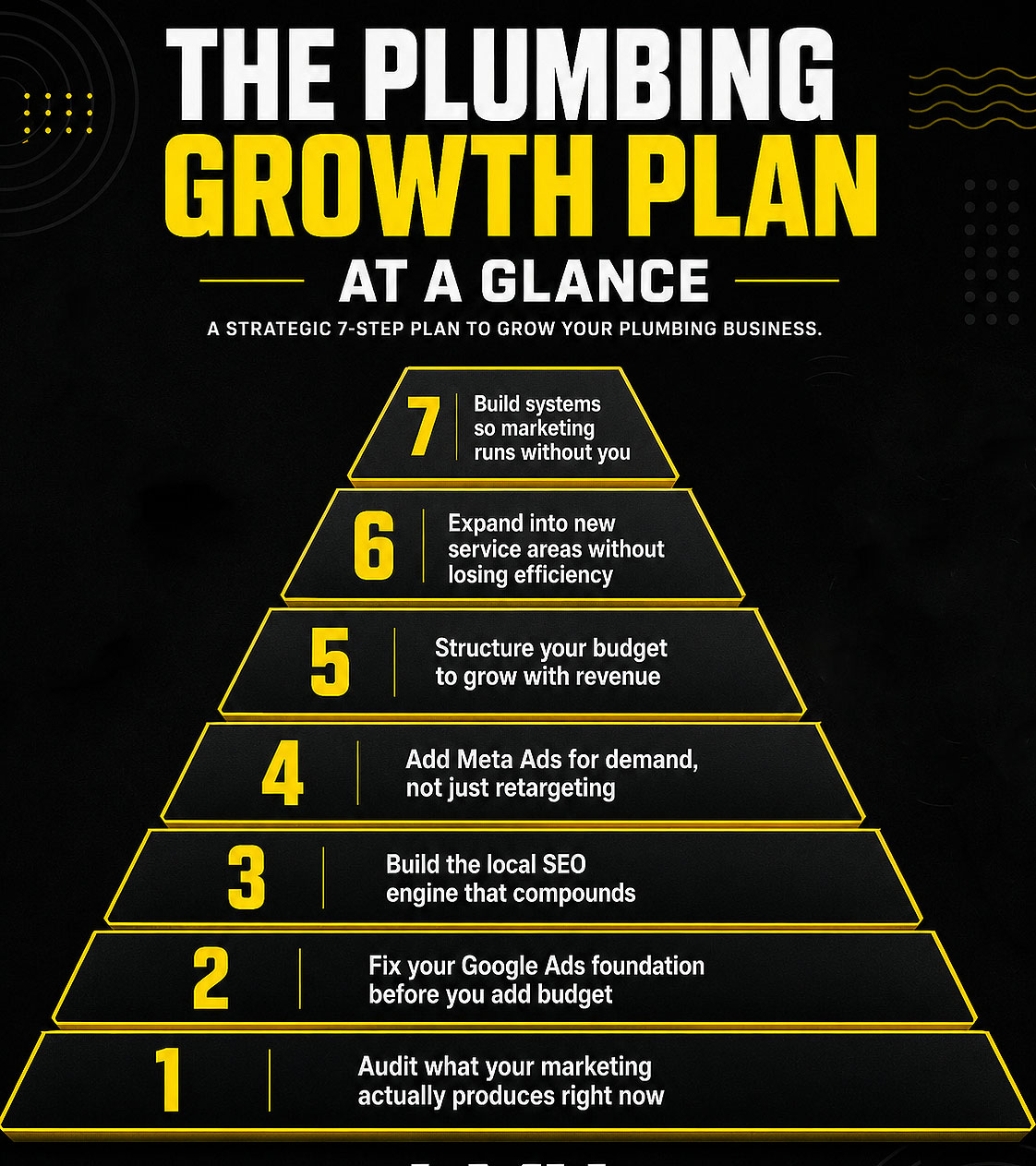
The Plumbing Growth Plan at a Glance
- Audit what your marketing actually produces right now
- Fix your Google Ads foundation before you add budget
- Build the local SEO engine that compounds
- Add Meta Ads for demand, not just retargeting
- Structure your budget to grow with revenue
- Expand into new service areas without losing efficiency
- Build systems so marketing runs without you
Work it top to bottom. Each step earns the right to the next one.
Step 1: Audit What Your Marketing Actually Produces Right Now
You cannot scale a number you have never measured, and what gets measured gets managed. Before you spend another dollar, pull the last 90 days and answer one question for every channel: what did a booked job cost here?
We are not looking for what a click cost or what a lead cost. We are looking for what a booked job cost. Line up Google Ads, Local Services Ads, organic search, your Google Business Profile, and any social spend, then divide what you paid by the jobs each one actually produced. Most owners are surprised. The channel that feels busy is often the one bleeding money, while the quiet one is carrying the business.
This only works if you are tracking calls. Plumbing is a phone-driven trade, and a form fill count tells you almost nothing when most emergency work starts with a call. Put dynamic call tracking in place first so every ring is tied to the source that earned it. We use WhatConverts for lead tracking and scoring on the accounts we manage, because a scored lead separates a burst pipe from a price shopper before you ever judge a channel.
Once you can see cost per booked job by source, the plan writes itself. Pause what loses money. Protect what wins. Then scale from there.
Step Two: Fix Your Google Ads Foundation Before You Add Budget
The fastest way to waste a bigger budget is to point it at a broken account. More spend on a weak structure just buys more of the wrong clicks.
Structure campaigns by intent first. A homeowner searching “water heater replacement” and one searching “burst pipe emergency plumber” are worth different bids and need different pages. Separate emergency work from installs so your budget follows the jobs you want more of. Then build a real negative keyword list. “Plumbing salary,” “how to fix,” and “parts near me” drain accounts every single day, and most owner run campaigns never block them.
Match every ad group to a landing page that answers that exact search. Sending emergency traffic to a generic homepage is where good clicks go to die. Check your geographic targeting so you are not paying for clicks two counties outside your service area. Only after the structure is clean and the cost per booked job is healthy do you scale spend. Get the paid ads foundation right, then pour fuel on it.

Step Three: Build the Local SEO Engine That Compounds
Paid ads stop the day you stop paying. Local SEO keeps working after the spend ends, which is why every plumbing company that scales well runs both.
Start with your Google Business Profile, because for local plumbing it often outperforms your website for calls. Keep the categories, service list, hours, and photos current, and treat reviews as the engine they are. Reviews do most of the trust work before anyone loads your site.
From there, give each real service area its own page. A city page for every market you serve with content that speaks to that town rather than a list of zip codes tells Google exactly where you belong. Keep your name, address, and phone identical across every directory so nothing contradicts your listing. This is the long game. Expect a real payoff around the 6 month mark, not next week. Our local SEO for plumbers work is built around that timeline, and it is the channel that lowers your blended cost per job the most once it matures.
Step Four: Add Meta Ads for Demand, Not Just Retargeting
Search captures people who already know they need a plumber. Meta Ads reach homeowners before the emergency, which is a different and valuable job. Used well, Facebook and Instagram create demand instead of just chasing it.
Target homeowners, not renters, and lead with a specific offer tied to the season. A water heater flush before winter or a drain special in spring gives people a reason to act now. Use real photos from real jobs. Your crew, your trucks, your work beats stock imagery or AI slop every time in this trade because it looks like the neighbor down the street, not an ad.
If you are new to the channel, start with retargeting. Show ads to people who already visited your site or called once. It is the cheapest, highest intent audience you have, and it is a low risk way to prove the channel before you spend on cold demand generation.
Step Five: Structure Your Budget to Grow With Revenue
A scaling budget moves with the business, not against it. A common planning range for home service companies is 6% to 12% of revenue on marketing, weighted higher when you are growing and lower when you are holding steady. Use that as a starting frame and then let your cost per booked job set the real number.
Split the budget by channel maturity. Proven winners get the most. New channels get a test budget you can afford to lose while you learn. Review the whole mix every quarter and move money toward what is working, because the winner from January is not always the winner in July. Build for plumbing’s seasons, too. Emergency demand spikes in the coldest and hottest weeks, so plan to lean in when intent is high rather than spreading spend flat across the year. One more line most owners forget: the cost of answering the phone. A missed call at 4:50 on a Friday is a job your marketing already paid for.
Fiscor Plumbing: What This Sequence Looks Like in the Field
We ran this exact order for Fiscor Plumbing and Air, a plumbing and HVAC company across three markets in Northern Arizona, in partnership with Nuve. We rebuilt the site, tuned the Google Business Profile, and layered local SEO, Google Ads, Local Services Ads, Microsoft Ads, and Meta on top, all tracked and scored through WhatConverts.
Paid leads grew from 499 in the first half of 2025 to 1,841 in the second half, close to a fourfold jump, and the business added another 1,155 in the first four months of 2026. The important part is what held while volume climbed: the quotable lead rate stayed around 48%, so more leads did not mean worse leads. Calls from the Business Profile rose 15 times over, profile interactions rose 31 times over, organic traffic converted 47% better, and brand searches grew fourfold. The result was multiple record breaking revenue months. You can read the full Fiscor case study for the details.

Step Six: Expand Into New Service Areas Without Losing Efficiency
New territory is where efficient scaling goes to die if you rush it. Before you add a market, make sure you can actually service it. Adding leads you cannot answer or crews you cannot staff just turns marketing spend into bad reviews.
When you are ready, treat the new area as its own effort. Build separate campaigns and its own city page so you can see its cost per booked job on its own, rather than hiding a weak market inside a strong one’s average. Expand your Google Business Profile presence carefully and within Google’s guidelines. Then watch the cost per job closely for the first 90 days. A new market almost always starts more expensive than your home turf, and that is fine as long as it is trending the right direction. If it is not, you catch it early because you built it to be measured.
Step Seven: Build Systems So Marketing Runs Without You
The final step is the one that separates a business you own from a job you can never leave. At some point the marketing has to run on systems, not on your attention.
Put automated reporting in place so you see cost per lead and booked jobs without pulling numbers by hand. Connect your CRM so you can trace a lead all the way to a paid invoice, which is the only view that tells you what your marketing is truly worth. Hand specialized work to specialists, whether that is an in house hire or an agency, and hold whoever runs your marketing to the metrics that matter: cost per booked job and revenue, never impressions or clicks. Review your tools each quarter and cut what you are paying for but not using. Systems are what let you add a market or a service line without adding a second full time job for yourself.
Where the Line Is Between DIY and a Team
You can start plenty of this alone. Any plumbing owner can pull 90 days of data, fix obvious wasted ad spend, and ask customers for reviews. That work pays off fast and costs nothing but time.
The line shows up when scaling starts to cost you more than it returns, or when running the marketing is eating the hours you should spend running the company. Managing intent based Google Ads, building out city pages that rank, and keeping a multi channel budget efficient across seasons is a full time discipline. If your cost per job is climbing as you grow, or your best channel is capped because no one has time to expand it, that is the signal to bring in a team. We do this every day for plumbing companies through our plumbing digital marketing work, and the goal is always the same: more booked jobs at a cost that gets better as you scale, not worse.
Start at Step One
If your lead flow looks like Fiscor’s did before we started, bursts and gaps instead of a steady line, the fix is not more spend. It is this sequence, run in order. Start at step one and work down. When you want a team that lives in these accounts every day, schedule a call and let us build something awesome.
Frequently Asked Questions
Scale your best proven channel first, and only after you can measure cost per booked job by source. For most plumbers that means a clean Google Ads account and an optimized Google Business Profile before anything else. Fix the leaks before you add new channels.
A common planning range is 8 to 12 percent of revenue, higher while you are growing. Treat that as a starting point, then let your cost per booked job set the real number. Spend more where the jobs are cheap and less where they are expensive.
Plan for a real payoff around 12 months, with earlier movement on your Google Business Profile and city pages. It is slower than paid ads, but it lowers your blended cost per job the most once it matures, and it keeps working after the spend stops.
Yes. Ads stop the day you stop paying, and SEO keeps producing after that. The two together lower your overall cost per job, because organic and Business Profile calls cost far less than paid clicks once they are established.
Hire a team when scaling starts costing more than it returns, or when running the marketing is stealing the time you need to run the business. If your cost per booked job climbs as you grow, that is the clearest sign the work has outgrown a DIY setup.
Citations and References
- Google Business Profile guidelines, Google: support.google.com/business
- Local Services Ads for service businesses, Google: ads.google.com/local-services-ads
- Fiscor Plumbing and Air case study, Lokal Media House: read the case study

Looking to Elevate Your Digital Marketing?
See How Our Expert Team Can Guide You!
Let’s Build Something AwesomeThe Wave Report
Your source for the latest in home-service marketing, creative design, and growth trends, powered by LMH.

How to Market an HVAC Company (Complete Guide)
Marketing an HVAC company comes down to doing the right things in the right order. Get the foundation right first, which means a complete Google...
Facebook Ads for HVAC Companies: What Actually Books Jobs, and When to Hire an Agency
Facebook ads work for HVAC companies. They just do not work the way most owners expect. This guide covers what actually books jobs on Facebook...

How Much Should HVAC Contractors Spend on Google Ads?
Your HVAC Google Ads budget is the output of four numbers you already have. Here is the math, the 2026 benchmarks to check it against,...